Music to soothe your soul.

Please join me in my journey to the strange and mysterious.
Showing posts with label sound. Show all posts
Showing posts with label sound. Show all posts
Monday, October 15, 2007


Sunday, March 18, 2007
The Sound of Music - Part 2
 "A person does not hear sound only through the ears;
he hears sound through every pore of his body.
It permeates the entire being,
and according to its particular influence either slows
or quickens the rhythm of the blood circulation;
it either wakens or soothes the nervous system.
It arouses a person to greater passions
or it calms him by bringing him peace.
According to the sound and its influence
a certain effect is produced.
Sound becomes visible in the form of radiance.
This shows that the same energy which goes into the form of sound
before being visible is absorbed by the physical body.
In that way the physical body recuperates
and becomes charged with new magnetism."
~ from 'Mysticism of Sound' by Hazrat Inayat Khan ~
"Do you know that our soul
is composed of harmony?"
~ Leonardo DaVinci ~
The bird is an animal almost universally exalted and accepted as symbolically being associated with the soul, as a messenger of the gods, as carriers of souls, an oracle or seen to possess the spirit of loved ones whilst also being a symbol of good or evil. The Ancient Greeks actually developed a science from the study of birds and their activities called 'Ornithomancy' and since then, birds have continued to feature heavily in folklore across the world even in the 20th-century imagination. It is no surprise that the modern Western super hero 'Superman' has the special ability to fly and is also given a name that indicates supreme powers. Perhaps this is because man has long wanted to be able to fly. Take the story of 'Icarus' as just one such further example.
In folklore birds are seen to possess the ability to talk offering guidance to humans. Carl G. Jung, the psychiatrist, (See Mystical WWW Philosophy), said that birds represented the inner spirit of a person and that birds were seen to be associated with angels, flights of fancy and the supernatural.
The Egyptians associated birds with the soul or 'ba', and the hawk specifically with the soul of 'Horus' and the pharaoh. Some Native American beliefs see the birds as personifications of the rain and the wind. Shamans are known for transforming into the shape of birds to be able to leave the body and soar up into the universe. The patron god of the ancient Aztec civilization was 'Huitzilopochtli'. The Aztecs believed that the dead were reborn as 'Colibris' which were the birds of their patron god, and hence held all birds in high esteem.
Mental health 'helped by birdsong'
Birdsong has a powerful healing effect which can improve mental health and benefit hospital patients, according to a health expert.
Dr William Bird, GP, who is a health adviser for the countryside agency, Natural England, said tests had proven the effect. He cites a 2004 report in the prestigious medical journal, Thorax, on the effects of birdsong on patients recovering from a lung operation. "They needed less pain relief and were far more relaxed," he said.
Dr Bird also recommended birdsong for the elderly and for those who suffer from high levels of stress. "We have lost our connection with nature," he said, adding: "By having birdsong, it's away of connecting back, and our mental health improves when that connection has been made."
Research has found that "ultra waves" increase in the brain when subjects are shown a natural scene, and Dr Bird said the same effect occured with birdsong.
Mark Avery, director of Conservation at the Royal Society for the Protection of Birds, said that bird sounds were a "tonic" for people's general wellbeing.
Wikipedia describes bird song - Bird songs are certain vocal sounds that birds make—in non-technical use, those sounds that are melodious to the human ear. In ornithology, bird 'songs' are often distinguished from shorter sounds, which may be termed 'calls'.
Musicologists believe that birdsong has had a large influence on the development of music. Although the extent of this influence is impossible to gauge, it is sometimes easy to see some of the specific ways composers have integrated birdsong with music.
There seem to be three general ways musicians or composers can be affected by birdsong: they can be influenced or inspired (consciously or unconsciously) by birdsong, they can include intentional imitations of bird song in a composition, or they can incorporate recordings of birds into their works.
One early example of a composition that imitates birdsong is Janequin's Le Chant Des Oiseaux, written in the 16th century. Other composers who have quoted birds, or who have used birdsong as a compositional springboard, include Biber (Sonata Representativa), Beethoven (Sixth Symphony), Wagner (Siegfried) and jazz musicians Paul Winter (Flyway) and Jeff Silverbush (Grandma Mickey).
Twentieth century French composer Olivier Messiaen deserves special mention, as he composed with birdsong extensively. His Catalogue d'Oiseaux is a seven-book set of solo piano pieces based upon birdsong. His orchestral piece Réveil des Oiseaux is composed almost entirely of birdsong. Many of his other compositions, including Quatuor pour la fin du temps, similarly integrate birdsong.
Italian composer Ottorino Respighi, with his The Pines of Rome (1923-1924), may have been the first to compose a piece of music that calls for the addition of pre-recorded birdsong. A few years later, Respighi wrote Gli Uccelli ("The birds"), based on Baroque pieces imitating birds.
American jazz musician Eric Dolphy sometimes listened to birds while he practiced flute. He claimed to have incorporated bird song into some of his improvisational music.
In the psychedelic era of the 1960's and 1970's, many rock bands included sound effects in their recordings. Birds were a popular choice. The English band Pink Floyd included bird sound effects in many of the songs from their 1969 albums More and Ummagumma (see, for example, the song Cirrus Minor). Similarly, the English singer Kate Bush incorporated bird sound effects into much of the music on her 2005 album, Aerial.
Music hall artist Ronnie Ronalde, has gained notoriety for his whistling imitations of birds and for integrating birdsong with human song. His songs 'In A Monastery Garden' and 'If I Were A Blackbird' include imitations of the blackbird, his "signature bird."
The French composer François-Bernard Mâche has been credited with the creation of zoomusicology, the study of the music of animals. His essay Musique, mythe, nature, ou les Dauphins d'Arion (1983)includes a study of "ornitho-musicology," in which he speaks of "animal musics" and a longing to connect with nature.
Bird song and poetry
Bird song is a popular subject in poetry. Famous poems inspired by bird song include Percy Bysshe Shelley's To a Skylark ("Hail to thee, blithe Spirit!/Bird thou never wert") and Gerard Manley Hopkins' Sea and Skylark.
Zoomusicology Zoomusicology is a field of musicology and zoology or more specifically, zoosemiotics. Zoomusicology is the study of the music of animals, or rather the musical aspects of sound or communication produced and received by animals.
Zoomusicology may be distinguished from ethnomusicology, the study of human music. Zoomusicology is most often biomusicological, and biomusicology is often zoomusicological.
In the opinion of Jean-Jacques Nattiez (1990), "in the last analysis, it is a human being who decides what is and is not musical, even when the sound is not of human origin. If we acknowledge that sound is not organized and conceptualized (that is, made to form music) merely by its producer, but by the mind that perceives it, then music is uniquely human." According to Mâche, "If it turns out that music is a wide spread phenomenon in several living species apart from man, this will very much call into question the definition of music, and more widely that of man and his culture, as well as the idea we have of the animal itself." (Mâche 1992: 95)
Shinji Kanki composes music for dolphins according to conventions found in dolphin music or found to please dolphins in his Music for Dolphins (Ultrasonic Improvisational Composition) for underwater ultrasonic loudspeakers (2001).
Composers have evoked or imitated animal sounds in compositions including Jean-Philippe Rameau's The Hen (1728), Camille Saint-Saëns's Carnival of the Animals (1886), Olivier Messiaen's Catalogue of the Birds (1956-58), and Pauline Oliveros's El Relicario de los Animales (1977). (Von Gunden 1983, p.133)
The icaros (sacred healing songs and chants) sung by ayahuasca healers, or shamanic practitioners, among Amazonian tribes are evocative of many of the sounds of birds, animals and insects of the jungle.
Twentieth century French composer Olivier Messiaen deserves special mention, as he composed with birdsong extensively. His Catalogue d'Oiseaux is a seven-book set of solo piano pieces based upon birdsong. His orchestral piece Réveil des Oiseaux is composed almost entirely of birdsong. Many of his other compositions, including Quatuor pour la fin du temps, similarly integrate birdsong.
Messiaen: Quartet for the End of Time
Messiaen uses rhythmic motifs of 17 notes and 29 notes which play together. The different prime numbers ensure that the motifs are constantly creating new combinations of sound as the music evolves. It gives the piece a sense of timelessness because it takes a very long time before the two motifs will repeat a pattern already heard. Messiaen is using the same principle as the prime number cicada who avoids its periodic predator by choosing a prime.
Messiaen wrote in the preface to the score that the work was inspired by text from the tenth chapter of the Book of Revelation:
"And I saw another mighty angel come down from heaven, clothed with a cloud: and a rainbow was upon his head, and his face was as it were the sun, and his feet as pillars of fire… and he set his right foot upon the sea, and his left foot on the earth… And the angel which I saw stand upon the sea and upon the earth lifted up his hand to heaven, and sware by him that liveth for ever and ever,… that there should be time no longer: But in the days of the voice of the seventh angel, when he shall begin to sound, the mystery of God should be finished…"
Messiaen list at youtube
Songbirds Update 1 March 2007
In 1986 Quantum brought you a story about two Aussie scientists who made a controversial discovery about the origin of songbirds. Dr Les Christidis and Dr Richard Schodde were mocked by the scientific community after claiming that many songbirds actually originated from Australia. Tonight, we revisit this story to find out if 20 years of scientific advancements have helped them silence the critics.
Whistled Languages
Whistled languages are a form of communication used by many indigenous people around the world. The languages differs according to whether the spoken language is tonal or not, with the whistling being either tone or articulation based. Tonal languages are stripped of articulation, leaving only suprasegmental features such as duration and tone, and when whistled retain the spoken melodic line. In non-tonal languages, some of the articulatory features of speech are retained, though the normally timbral variations imparted by the movements of the tongue and soft palate are transformed into pitch variations.
Thus whistled languages convey phonemic information solely through tone, length, and, to a lesser extent, stress, and many phonemic distinctions of the spoken language are lost. "All whistled languages share one basic characteristic: they function by varying the frequency of a simple wave-form as a function of time, generally with minimal dynamic variation, which is readily understandable since in most cases their only purpose is long-distance communication." (ibid: 32)
Languages communicated by whistling are relatively rare, but are known from around the world. One example is the Silbo on the island of La Gomera in the Canary Islands, which maintains Spanish's five vowels, but reduces its consonants down to four. Others exist or existed in all parts of the world including Turkey (Kusköy "Village of the Birds"), France (the village of Aas in the Pyrenees), Mexico (the Zapotecs of Oaxaca), South America (Piraha), Asia (the Chepang of Nepal), and New Guinea. They are especially common and robust today in parts of West Africa, used widely in such populous languages as Yoruba and Ewe. Even French is whistled in some areas of western Africa.
In continental Africa, speech may be conveyed by a whistle or other musical instrument, most famously the "talking drums". However, while drums may be used by griots singing praise songs or for inter-village communication, and other instruments may be used on the radio for station identification jingles, for regular conversation at a distance whistled speech is used. As two people approach each other, one may even switch from whistled to spoken speech in mid-sentence.
In the Greek village of Antia, the entire population knows how to whistle their speech, and whistled conversations are also carried on at close range.
As the expressivity of whistled speech is limited compared to spoken speech, whistled messages typically consist of stereotyped or otherwise standardized or set expressions, are elaborately descriptive, and often have to be repeated.
However, in languages which are heavily tonal, and therefore convey much of their information through pitch even when spoken, such as Mazatec and Yoruba, extensive conversations may be whistled.
In Africa and indigenous Mexican communities, whistled language is used only by men.
Whistled languages are normally found and used in locations with abrupt relief created by difficult mountainous terrain, slow or difficult communication (no telephones), low population density and/or scattered settlements, and other isolating features such as sheepherding and cultivation of hillsides.
The main advantage of whistling speech is that it allows the speaker to cover much larger distances (typically 12 km but up to 5 km) than ordinary speech, and this is assisted by the relief found in areas where whistled languages are used. In practice, many areas with such languages work hard to preserve their ancient traditions, in the face of rapidly advancing telecommunications systems in many areas.
A whistled tone is essentially a simple oscillation (or sine wave), and thus timbral variations are impossible. Normal articulation during an ordinary lip-whistle is relatively easy though the lips move little causing a constant of labialization and making labial and labiodental consonants (p, b, m, f, etc.) impossible.
January 5, 2005 - National Geographic
Shepherds who whistle to each other across the rocky terrain of the Canary Islands off northwest Africa are shedding light on the language-processing abilities of the human brain, according to scientists.
Researchers say the endangered whistled "language'" of Gomera island activates parts of the brain normally associated with spoken language, suggesting that the brain is remarkably flexible in its ability to interpret sounds as language.
"Science has developed the idea of brain areas that are dedicated to language, and we are starting to understand the scope of signals that can be recognized as language," said David Corina, co-author of the study and associate professor of psychology at the University of Washington in Seattle.
Silbo Gomero is a substitute for Spanish, with individual words recoded into whistles. Vowels and consonants are replaced by tones that are whistled at different frequencies. ("Silbo" comes from the Spanish "silbar" -to whistle.)
Known as silbadores, the whistlers of Gomera are traditionally shepherds and other isolated mountain folk. Their novel means of staying in touch allows them to communicate over long distances - Silbador whistles can travel up to six miles (ten kilometers). "Spanish consonants are mapped into four different whistles and the five vowels into two whistles," explained lead researcher Manuel Carreiras, psychology professor at the University of La Laguna on the Canary island of Tenerife. "There is much more ambiguity in the whistled signal than in the spoken signal," he added.
Because whistled "words" can be hard to distinguish, silbadores also rely on repetition and context to make themselves understood.
Monday, February 26, 2007
The Sound of Music - Part 1
 The Music of the Ainur
There was Eru, the One, who in Arda is called Illuvatar: and he made the first Ainur, the Holy Ones, that were the offspring of his thought, and they were with him before aught else was made. And he spoke to the, propounding to them themes of music; and they sang before him, and he was glad. But for a long while they sang only each alone, or but few together, while the rest hearkened; for each comprehended only that part of the mind of Iluvatar from which he came, and in the understanding of their brethren they grew but slowly. Yet ever as they listened they came to deeper understanding, and increased in unison and harmony.
And it came to pass that Illuvatar called together all the Ainur and declared to them a mighty theme, unfolding to them things greater and more wonderful than he had yet revealed; and the glory of its beginning and the splendor of its end amazed the Ainur, so that they bowed before Illuvatar and were silent.
Then Illuvatar said to them: “Of the theme that I have declared to you, I will now make ye make in harmony together a Great Music. And since I have kindled you with the Flame Imperishable, ye shall show forth your powers in adorning this theme, each with his own thoughts and devices, if he will. But I will sit and hearken, and be glad that through you great beauty has been wakened into song.”
Then the voice of the Ainur, like unto harps and lutes, and pipes and trumpets, and viols and organs, and like unto countless choirs singing with words, began to fashion the theme of Illuvatar to a great music; and a sound arose of endless interchanging melodies woven in harmony that passed beyond hearing into the depths and into the flowing, and the music and the echo of the music went out into the Void, and it was not void. Never since have the Ainur made any music like to this music, though it has been said that a greater still shall be made before Illuvatar by the choirs of the Ainur and the Children of Illuvatar after the end of days. Then the themes of Illuvatar shall be played aright, and take being in the moment of their utterance, for all shall then understand fully his intent in their part, and each shall know the comprehension of each, and Illuvatar shall give to their thoughts the secret fire, being well-pleased
The fact that the "world is sound" isn't just a widespread myth or legend. It is confirmed in the established findings of fundamental harmonic research and many other disciplines. We have found the world's tonal character confirmed in DNA genes and electron spins, in the solar wind and geomagnetism, in the weather and in the "song" of flowers and plants. Ever since the time of his incarnation, man has progressively lost his original spiritual perception. This has worked to divorce music and language from the natural harmonies and rhythms, which were and remain the primordial condition of all things.
-Jocelyn Godwin
-Jocelyn Godwin
http://fusionanomaly.net/auroraborealis.html
AURORAL SOUNDS
March 13, 1989. This night on a cattle ranch in South Dakota, L. Hasselstrom was dazzled by waves of blue auroral light sweeping up from the horizon and meeting at a focal point nearly directly overhead. As the sky blazed, with the blue waves and crimson streamers, she heard:
"...a distant tinkling, like bells. It came again, louder, just as a curtain of green light swept the entire width of the sky from north to south. Each time green flushed the sky, the bells rang, the sound softening to a gentle tinkle as the light died."
(Hasselstrom, Linda; "Night of the Bells," Readers Digest, p. 185, April 1992. Cr. J.B. Dotson.)
Comment. Note the correlation of the sound with the green portion of the aurora.
July 29, 1990. On Coll Island in Centennial Lake, 120 kilometers west of Ottawa. Watching an auroral display, L.R. Morris heard the sound of the aurora:
"It was a faint but distant windlike sound; which, by process of elimination, could not be accounted for by any phenomenon other than the aurora."
(Anonymous; "Auroral Sounds," Sky & Telescope, 83:105, January 1992. Cr. D. Snowhook.)
Comment. Auroras have been heard for centuries, but they "shouldn't be." Current theory restricts auroral activity to altitudes above 50 miles, where a fair vacuum prevails, and sound generation and propagation are impossible. One explanation for auroral sounds is that intense electromagnetic waves created by the auroras sweep through thee observer's brain and are rendered as sound (electrophonic sound). But perhaps some auroras reach down lower into the atmosphere than theory allows.
AURORAL SOUNDS
March 13, 1989. This night on a cattle ranch in South Dakota, L. Hasselstrom was dazzled by waves of blue auroral light sweeping up from the horizon and meeting at a focal point nearly directly overhead. As the sky blazed, with the blue waves and crimson streamers, she heard:
"...a distant tinkling, like bells. It came again, louder, just as a curtain of green light swept the entire width of the sky from north to south. Each time green flushed the sky, the bells rang, the sound softening to a gentle tinkle as the light died."
(Hasselstrom, Linda; "Night of the Bells," Readers Digest, p. 185, April 1992. Cr. J.B. Dotson.)
Comment. Note the correlation of the sound with the green portion of the aurora.
July 29, 1990. On Coll Island in Centennial Lake, 120 kilometers west of Ottawa. Watching an auroral display, L.R. Morris heard the sound of the aurora:
"It was a faint but distant windlike sound; which, by process of elimination, could not be accounted for by any phenomenon other than the aurora."
(Anonymous; "Auroral Sounds," Sky & Telescope, 83:105, January 1992. Cr. D. Snowhook.)
Comment. Auroras have been heard for centuries, but they "shouldn't be." Current theory restricts auroral activity to altitudes above 50 miles, where a fair vacuum prevails, and sound generation and propagation are impossible. One explanation for auroral sounds is that intense electromagnetic waves created by the auroras sweep through thee observer's brain and are rendered as sound (electrophonic sound). But perhaps some auroras reach down lower into the atmosphere than theory allows.
The Sun emits a constant stream of charged particles (for convenience, the "Solar wind"). As you probably know, any moving electric charge creates a magnetic field, and vice versa. This Solar wind, in turn, interferes with various earthbound fields to cause such astounding phenomena as the aurora borealis, or 'northern lights' (it also causes comet trails, which is why the trails always point away from the sun, even when the comet is on its way back 'out' of the solar system).
http://fusionanomaly.net/planetthathums.html
The planet that hums
by Robert Coontz from _New Scientist_ September 11, 1999
THEY LIVE UNDERGROUND. They are everywhere but seem to come from nowhere. They barely exist, but never leave. If sounds have shadows, they are the shadows of a sound.
Researchers call them the background free oscillations of the Earth. But last year, when a pair of Japanese geophysicists named Naoki Suda and Kazunari Nawa dredged them out of a mass of seismic data, some people called them a hum. That's a comforting thought: a mystic Om, perhaps, or just the warm, cosy sound of a planet going about its business.
Don't try to tune in, you'll never hear it, though. The Hum is far too low for human ears to detect and is so feeble that a single 5.5-magnitude earthquake can blot it out. That's just as well because, if you could hear it, the Hum might drive you mad.
"It's a very messy noise," says Hiroo Kanamori, a geophysicist at the California Institute of Technology. Messy because the Hum is not one note but fifty, crammed into less than two octaves. Their pitches range between 2 and 7 millihertz. Musically speaking, that's about sixteen octaves below middle C. Speeded up and amplified so you could hear it, the result would be a Stockhausenesque cacophony. Imagine sitting down at a piano and slamming down every note within reach, while somebody next to you does the same thing on a piano a quarter tone out of tune. "It would be like banging a trash can," Kanamori says. Endlessly.
The individual notes are pleasant enough. They are the natural tones that the Earth makes whenever something--an earthquake, a meteor, a nuclear test--sets it ringing. They are known as "free" oscillations because, like the clang of a bell or the twang of a guitar string, they keep on sounding for a while after their source is gone.
The planet that hums
by Robert Coontz from _New Scientist_ September 11, 1999
THEY LIVE UNDERGROUND. They are everywhere but seem to come from nowhere. They barely exist, but never leave. If sounds have shadows, they are the shadows of a sound.
Researchers call them the background free oscillations of the Earth. But last year, when a pair of Japanese geophysicists named Naoki Suda and Kazunari Nawa dredged them out of a mass of seismic data, some people called them a hum. That's a comforting thought: a mystic Om, perhaps, or just the warm, cosy sound of a planet going about its business.
Don't try to tune in, you'll never hear it, though. The Hum is far too low for human ears to detect and is so feeble that a single 5.5-magnitude earthquake can blot it out. That's just as well because, if you could hear it, the Hum might drive you mad.
"It's a very messy noise," says Hiroo Kanamori, a geophysicist at the California Institute of Technology. Messy because the Hum is not one note but fifty, crammed into less than two octaves. Their pitches range between 2 and 7 millihertz. Musically speaking, that's about sixteen octaves below middle C. Speeded up and amplified so you could hear it, the result would be a Stockhausenesque cacophony. Imagine sitting down at a piano and slamming down every note within reach, while somebody next to you does the same thing on a piano a quarter tone out of tune. "It would be like banging a trash can," Kanamori says. Endlessly.
The individual notes are pleasant enough. They are the natural tones that the Earth makes whenever something--an earthquake, a meteor, a nuclear test--sets it ringing. They are known as "free" oscillations because, like the clang of a bell or the twang of a guitar string, they keep on sounding for a while after their source is gone.
http://www.capallbann.co.uk/popup.cfm?p_n=25000&p_i=25000
Music and the Earth Spirit
This is a book about music and sound; a multi-cultural exploration from pre-history to the present day, revealing how man has used these forms to commune with nature and the environment. Underlying this communion is an acknowledgement of the spiritual powers of Mother Earth herself. The author shows how music and sound can be used to enable a "tuning" into this spirit. The book includes sound workings enabling the reader to sing his/her own Earth spirit song. ISBN 186163 1170
Price: £9.95
Music and the Earth Spirit
This is a book about music and sound; a multi-cultural exploration from pre-history to the present day, revealing how man has used these forms to commune with nature and the environment. Underlying this communion is an acknowledgement of the spiritual powers of Mother Earth herself. The author shows how music and sound can be used to enable a "tuning" into this spirit. The book includes sound workings enabling the reader to sing his/her own Earth spirit song. ISBN 186163 1170
Price: £9.95
The mystery of chanting.
Om also Aum (om) noun
Hinduism & Buddhism.
The supreme and most sacred syllable, consisting in Sanskrit of the three sounds (a), (u), and (m), representing various fundamental triads and believed to be the spoken essence of the universe. It is uttered as a mantra and in affirmations and blessings.
[Sanskrit om.]
OM
The imperishable sound,
is the seed of all that exists.
The past, present, the future,
all are but the unfolding of OM.
And whatever transcends the three realms of time,
that indeed is the flowering of OM.
This pure self and OM are as one,
and the different quarters of the self
correspond to OM and its sounds.
--Mandukya Upanishad
The Masonic Secret Word:
Not to be confused with the password. The Word (always capitalized) is so secret that initiates are taught it one letter at a time. First they learn A, then O, then M, and finally I. The Word is IAOM.
You never get a straight story as to what it means. As best as anyone can figure, it is the ineffable name of god, or some approximation thereof. The Word (or Name) is a tongue-twister. It takes some practice to get it right. The following pronunciation guide is from _Masonry and Its Symbols in the Light of Thinking and Destiny_ by Harold Waldwin Percival:
The Name is pronounced as follows: It is started by opening the lips with an "ee" sound graduating into a broad "a" as the mouth opens wider with lips forming an oval shape and then graduating the sound to "o" as the lips form a circle, and again modulating to an "m" sound as the lips close to a point. This point resolves itself to a point within the head. Expressed phonetically the Name is "EE-Ah-Oh-Mmm" and is pronounced with one continuous out-breathing with a slight nasal tone in the manner described above. it can be correctly and properly expressed with its full power only by one who has brought his physical body to a state of perfection...
from: _Big Secrets_ by William Poundstone
Hinduism & Buddhism.
The supreme and most sacred syllable, consisting in Sanskrit of the three sounds (a), (u), and (m), representing various fundamental triads and believed to be the spoken essence of the universe. It is uttered as a mantra and in affirmations and blessings.
[Sanskrit om.]
OM
The imperishable sound,
is the seed of all that exists.
The past, present, the future,
all are but the unfolding of OM.
And whatever transcends the three realms of time,
that indeed is the flowering of OM.
This pure self and OM are as one,
and the different quarters of the self
correspond to OM and its sounds.
--Mandukya Upanishad
The Masonic Secret Word:
Not to be confused with the password. The Word (always capitalized) is so secret that initiates are taught it one letter at a time. First they learn A, then O, then M, and finally I. The Word is IAOM.
You never get a straight story as to what it means. As best as anyone can figure, it is the ineffable name of god, or some approximation thereof. The Word (or Name) is a tongue-twister. It takes some practice to get it right. The following pronunciation guide is from _Masonry and Its Symbols in the Light of Thinking and Destiny_ by Harold Waldwin Percival:
The Name is pronounced as follows: It is started by opening the lips with an "ee" sound graduating into a broad "a" as the mouth opens wider with lips forming an oval shape and then graduating the sound to "o" as the lips form a circle, and again modulating to an "m" sound as the lips close to a point. This point resolves itself to a point within the head. Expressed phonetically the Name is "EE-Ah-Oh-Mmm" and is pronounced with one continuous out-breathing with a slight nasal tone in the manner described above. it can be correctly and properly expressed with its full power only by one who has brought his physical body to a state of perfection...
from: _Big Secrets_ by William Poundstone
Dealing wirh sound means dealing with listening. Experiments have shown that no other sense can register impulses as minimal as those that the ear can register. The amplitude of the vibrations of our eardrum lies in the area of 10 [to the] -9 [power]. That is smaller than the wave length of visible light and even less than the diameter of a hydrogen atom. The smallest stimuli our ear can just barely perceive, on the other hand, have to be amplified by a factor of 10 [to the] 6 [power] in order to reach the level of the highest volume perceivable, by a factor in the million range. Were we to amplify the smallest impulses our eyes can register by the same factor, we would be blinded instantly. Hans Kayser points out the astonishing fact that our ears are the only human sense organ that is able to perceive numerical quantity as well as numerical value.
"The ears not only recognize exact numerical proportions, that is, numerical quantities like 1:2 as an octave, 2:3 as a fifth, 3:4 as a fourth, etc.; at the same time they hear ... values that they perceive as C, G, F, and so on. So the tone value fuses two elements into one unit: the element of sensing--the tone, that is--with the element of thinking, of numerical value. And this happens in such an exact manner that the value of the tone can be checked precisely against the value of the number, and the value of the number against the value of the tone.
"Among all our human senses we only have one organ that is capable of this fusion--the ears. In this way sensation controls deliberation--or to put it differently: Our soul is thus capable of deciding on the correctness or incorrectness of an intellectual quantity. Conversely, the phenomenon of tone value also gives us the opportunity to develop proportions and numerical values in the realm of the psyche."
"The ears not only recognize exact numerical proportions, that is, numerical quantities like 1:2 as an octave, 2:3 as a fifth, 3:4 as a fourth, etc.; at the same time they hear ... values that they perceive as C, G, F, and so on. So the tone value fuses two elements into one unit: the element of sensing--the tone, that is--with the element of thinking, of numerical value. And this happens in such an exact manner that the value of the tone can be checked precisely against the value of the number, and the value of the number against the value of the tone.
"Among all our human senses we only have one organ that is capable of this fusion--the ears. In this way sensation controls deliberation--or to put it differently: Our soul is thus capable of deciding on the correctness or incorrectness of an intellectual quantity. Conversely, the phenomenon of tone value also gives us the opportunity to develop proportions and numerical values in the realm of the psyche."
The German poet Goethe aptly described architecture as "frozen music". Spatial periodicities are the analogs of "rhythm" in music. As we will see, spatial periodicities can be more than analogues of musical sounds. They can introduce audible, tonal elements of their own!
When periodic design elements are composed of sound reflective materials (such as stone), and if certain other conditions are met, odd echoes or other strange acoustical effects may result.
When periodic design elements are composed of sound reflective materials (such as stone), and if certain other conditions are met, odd echoes or other strange acoustical effects may result.
Go here to read of recent discoveries scientists have made regarding ancient sites that seem to have been designed "as music".
Mayan temples
http://www.crystalinks.com/rosslynchapel.html
Rosslyn Chapel
Rosslyn Chapel
listen to the Rosslyn Motet
Stockhausen, Karlheinz
Stockhausen, Karlheinz (1928- ), German composer, who was one of the most prominent avant-garde composers of the mid-20th century. He was born in Cologne. In 1953 Stockhausen helped found Cologne's important Electronic Music Studio. His works include the wind quintet Time Measure (1956); Gruppen (1955-1957), written for three orchestras; Zyklus (1961), for solo percussionist; the multimedia work Beethausen, opus 1970, von Stockhoven (1970); and the chamber works Ylem (1973) and Tierkreis (1977). Youthsong (1956) projects a singing boy's voice, mingled with electronic sounds, through five spatially separated loudspeakers.
In the book _Stockhausen: towards A Cosmic Music_, the German avant-garde composer Karlheinz Stockhausen describes the human body as an indredibly complicated vibrating instrument of perception. The composer, who travels the vast spaceways that link electronic music and mysticism, argues that the "esoteric" is simply that which cannot yet be explained by science.
"Every genuine composition makes conscious something of this esoteric realm. This process is endless, and there will be more and more esotericism as knowledge and science become increasingly capable of revealing human beings as perceivers." And transmitters as well. Spiritual or not, we are beings of vibrating sensation, floating in an infinite sea of pulsing waves that roll and resonate between the synapse and the farthest star.
Paul McCartney listened to composer Karlheinz Stockhausen, a messiah in the world of electronic music but to the mid-60s pop star an unknown commodity. It was the German's 1956 'plick-plop' piece t - _Gesang der Junglinge_, a boy's voice construed and converted with a panoply of electronic sounds, that inspired McCartney to utilize his Brennell tape recorders for less conventional purposes, as Stockhausen himself had done the previous decade. McCartney, an advocate of all things melodious, had undergone a reformation of thought, no longer subscribing to the ingrained belief that rhythm, time signatures and even melody were essential.
The Beatles' musical language expanded incredibly in their consummate masterpiece, _Sgt. Pepper's Lonely Hearts Club Band_ (Parlophone: June 1, 1967). The album was a potpourri of rock 'n' roll, Western classical music, Indian classical music, early 20th-century vaudeville music, and modern electronic music employing compositional techniques such as indeterminacy and playing tapes backwards, as pioneered by the composer Karlheinz Stockhausen whose photo appeared on the album cover along with a host of other celebrities.

cover art depicts Stockhausen, top row, fifth person from left.
http://music.netscape.com/story/2006/11/27/-beatles-music-to-start-entering-uk-public-domain-in-2012
Beatles music to start entering the public domain in "2012"!
Should music be free?
http://fusionanomaly.net/freemusicphilosophy.html
I always tell people, music is a form of communication that predates language, straight up. It's been around forever. And it wasn't until about the turn of the century that they figured out a way to bottle the water, you know? Before that, music was a river. It was a river and everyone could sip from that river. But then someone came along with the idea that, "Hey, we can bottle this, and we can sell this water." And people were like, "Well, that's kind of cool, that's convenient, because I can take it home with me, or I can put it in my pocket and take it on a walk and have something to drink," which is fine. That's a reasonable industry, to go ahead and put some water in a bottle and sell it. That's fine. But the problem is when they start trying to discourage people from going to the river, or trying to close the river, or even worse, poison the river -- then it's not all right. Then it stinks.
And, for me, music is not an industry. Music is not even entertainment. Music is not just a soundtrack. Music is part of life. It is a straight-up form of communication, and it resides in every person in the world. And that's where I'm coming from in terms of music. That's exactly the world that I want to be… that's what I want to lean toward. It's sort of like clothes -- you live in a cold climate in a country that has these kinds of laws that you have to wear pants all the time, but basically, they're fairly artificial, they're a bizarre thing when you think about it. If you think about it, the whole deal is weird -- why does everyone have to wear clothes all the time? But that's the context in which I exist. I can appreciate [it] and I can go on with that. At the same time, when it comes to music, there are certain elements of what we do with music that are just distasteful. If people see music as just a living, they're just screwed. They're just gonna make something that's not music, in my opinion. But there are plenty of other people out there who are making incredible music who are not even thinking about money, and that's really where you're gonna find all the new ideas. It's always in the free space.
- Ian MacKaye - interview with Mike Watt of Minutemen/fIREHOSE
I always tell people, music is a form of communication that predates language, straight up. It's been around forever. And it wasn't until about the turn of the century that they figured out a way to bottle the water, you know? Before that, music was a river. It was a river and everyone could sip from that river. But then someone came along with the idea that, "Hey, we can bottle this, and we can sell this water." And people were like, "Well, that's kind of cool, that's convenient, because I can take it home with me, or I can put it in my pocket and take it on a walk and have something to drink," which is fine. That's a reasonable industry, to go ahead and put some water in a bottle and sell it. That's fine. But the problem is when they start trying to discourage people from going to the river, or trying to close the river, or even worse, poison the river -- then it's not all right. Then it stinks.
And, for me, music is not an industry. Music is not even entertainment. Music is not just a soundtrack. Music is part of life. It is a straight-up form of communication, and it resides in every person in the world. And that's where I'm coming from in terms of music. That's exactly the world that I want to be… that's what I want to lean toward. It's sort of like clothes -- you live in a cold climate in a country that has these kinds of laws that you have to wear pants all the time, but basically, they're fairly artificial, they're a bizarre thing when you think about it. If you think about it, the whole deal is weird -- why does everyone have to wear clothes all the time? But that's the context in which I exist. I can appreciate [it] and I can go on with that. At the same time, when it comes to music, there are certain elements of what we do with music that are just distasteful. If people see music as just a living, they're just screwed. They're just gonna make something that's not music, in my opinion. But there are plenty of other people out there who are making incredible music who are not even thinking about money, and that's really where you're gonna find all the new ideas. It's always in the free space.
- Ian MacKaye - interview with Mike Watt of Minutemen/fIREHOSE
Some musical samples to tickle your ears
Listen to your DNA (it's beautiful)
http://www.harmonicconvergence2012.com/music.htm
Harmonic convergence sound samples
Harmonic convergence sound samples
Sunday, October 01, 2006
Music, Life, and Good Vibrations
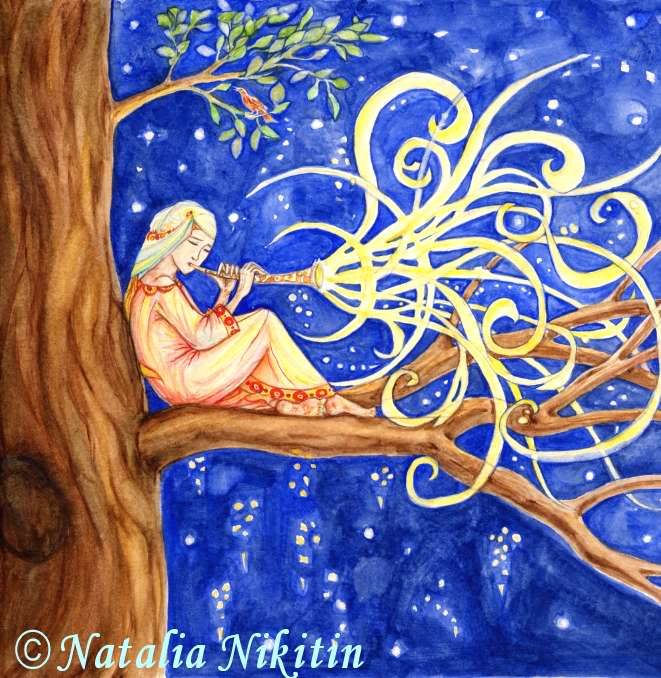
Music/Good Vibrations
'Many say that life entered the human body by the help of music, but the truth is that life itself is music.' Hafiz (Persian Sufi poet)
Faith
is a bird that feels dawn breaking
and sings while it is still dark
"SOUND" NUTRITION: Will Music Eliminate World Hunger? - Edith Kermit Roosevelt
Tomorrow's food and fuel may be supplied by plants on a diet of music and spray of hormones, chelated amino acids and trace minerals. That's the vision of Plant Scientist Dan Carlson, who foresees a Jack-in-the-Beanstalk world with gigantic flora feeding the multitudes and replenishing the earth's supply of life-giving oxygen.
"I believe that birds act as scouts for nature," he says. "Their songs act as a harmonic trigger in the spring time, breaking the dormancy in the seeds just as sound tape opens up the plant's potential for growth. The same relationship comes to mind when birds migrate from their habitats in the fall of the year. Then plants go into dormancy.
"Crickets with their chirping play the same role in causing night plants to grow," he goes on to say. "And we now experience the consequences of decreasing the number of different harmonic resonators in the decline of our forests."
Well, it's taken me forever to get the "guts" to start posting on here again. I've been surfing and reading and learning. It's been quite a wonderful journey.
I had become quite inhibited because I had ran across so many on the web, that I call "intellectual elites". They sneer at my little old views of enlightment. I felt inferior in some way, and ashamed in some way of who I am.
But I realize that I am just as important as anyone else. However I interpret the universe and the boundless love therein, is fine.
And who knows, in my own little way perhaps my song might be beautiful.
I'm ready to sing some more. Slightly off tune, and off kilter, but that's ok.
Jackson Brown – Lawyers in Love
His words couldn’t be more appropriate today
I can't keep up with what's been going on
I think my heart must just be slowing down
Among the human beings in their designer jeans
Am i the only one who hears the screams
And the strangled cries of lawyers in love
God sends his spaceships to america, the beautiful
They land at six o'clock and there we are, the dutiful
Eating from tv trays, tuned into to happy days
Waiting for world war iii while jesus slaves
To the mating calls of lawyers in love
Last night i watched the news from washington, the capitol
The russians escaped while we weren't watching them, like russians will
Now we've got all this room, we've even got the moon
And i hear the u.s.s.r. will be open soon
As vacation land for lawyers in love
As if i really didn't understand
That i was just another part of their plan
I went off looking for the promise
Believing in the motherland
And from the comfort of a dreamer's bed
And the safety of my own head
I went on speaking of the future
While other people fought and bled
The kid i was when i first left home
Was looking for his freedom and a life of his own
But the freedom that he found wasn't quite as sweet
When the truth was known
I have prayed for america
I was made for america
It's in my blood and in my bones
By the dawn's early light
By all i know is right
We're going to reap what we have sown
As if freedom was a question of might
As if loyalty was black and white
You hear people say it all the time-
"my country wrong or right"
I want to know what that's got to do
With what it takes to find out what's true
With everyone from the president on down
Trying to keep it from you
The thing i wonder about the dads and moms
Who send their sons to the vietnams
Will they really think their way of life
Has been protected as the next war comes?
I have prayed for america
I was made for america
Her shining dream plays in my mind
By the rockets red glare
A generation's blank stare
We better wake her up this time
The kid i was when i first left home
Was looking for his freedom and a life of his own
But the freedom that he found wasn't quite as sweet
When the truth was known
I have prayed for america
I was made for america
I can't let go till she comes around
Until the land of the free
Is awake and can see
And until her conscience has been found
How long will it take to find the higher power moving in me?
Power in the insect
Power in the sea
Power in the snow falling silently
Power in the blossom
Power in the stone
Power in the song being sung alone
Power in the wheatfield
Power in the rain
Power in the sunlight and the hurricane
Power in the silence
Power in the flame
Power in the sound of the lover's name
The power of the sunrise and the power of a prayer released
On the edge of my country, i pray for the ones with the least
Hunger in the midnight, hunger at the stroke of noon
Hunger in the banquet, hunger in the bride and groom
Hunger on the tv, hunger on the printed page
And there's a god-sized hunger underneath the questions of the age
And an absence of light
In the deepening night
Where i wait for the sun
Looking east
It’s always darkest before the dawn. Keep the faith.
Subscribe to:
Posts (Atom)