Sunday, December 02, 2018

She has come Home

https://www.elephantjournal.com/2018/11/she-always-knew-this-day-would-come/?fbclid=IwAR1n4FLKV9Zx_q4WJwVOr7KV3lpnFw9X-2Mfz1IcrxnwR_lgq42BMaFYZ3g

She has come Home. {Poem}
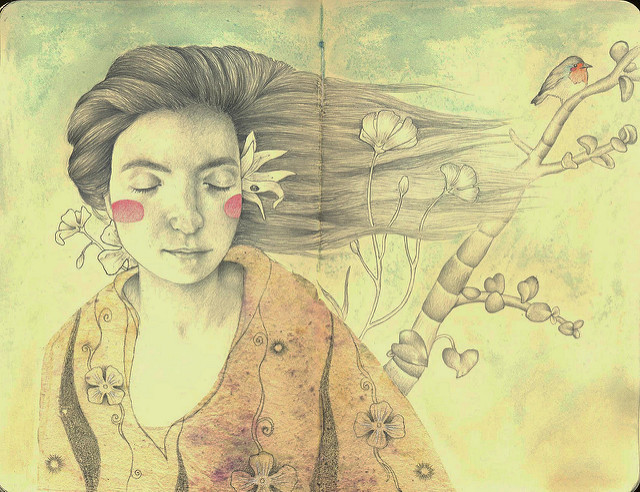


She always knew this day would come.


The day when she would embody herself completely.

The day when all the things other people thought of her and the cute, convenient little things they wanted her to be would blow away like brittle, red leaves in the crisp fall air—taking with them the old wounds.

And it’s not just death. It’s not just the wild breath of release.

It’s the space for something so much more.

Because she is fire.
The kind of fire that’s like water—sensitive, soft, empathic, and powerful exactly because of those things.

And her waters can bubble, they can gush and churn and heat up—they can shock and make sh*t happen.

But now—

Now, it’s all in the way she roots, closer to the ground.

No more hiding. No more quieting. No more muting that voice inside her that just knows. 
She glistens now, the way wildflowers do in the tender first light of the morning, right before the sun explodes into the sky. She listens now, to the truth that resides within.
She always knew this day would come.
The day when all the noisy definitions given to her by society—and all the scripted, hollow crap that women are supposed to be—would peel away.
She is left raw, naked, exposed—and an exquisite quiet, a deep tenderness permeates from the atmosphere, like the first flakes of falling snow.
It feels scary, yes. Maybe even stark or strange.
But there is wholeness.
Integration.
Power.
The delicious understanding that she doesn’t have to be anything in particular.
She can be herself—oh, yes—and that is enough.
It is vast, sweet, wild, beautiful, and strong. It is resilient. It is messy and complicated. And it is not the story read aloud to her about what she should be. It is not even written in the lines relayed to her about what an empowered woman looks like.
No.
She gets to write this book. She gets to pen the definitions that feel just right.
Because she is fire. The kind of fire that risks it all to be authentic, rather than a flimsy sliver of herself.
And it’s not just about rising—it’s about the thing she always avoided—
Rooting.
Now, it’s all about being her body—daring to fully inhabit the delightful flesh of her legs, breasts, arms, and the bowl of her pelvis. Oh, yes! Her skin rejoices.
She has come home.
A deep, resounding song echoes in her belly, the vibration spreading through the lusciousness of her entire body.
She sends her roots deep, deep into the molten, muddy center of the earth. And it feels so good.
And this day—it has a sparkle, a glisten mostly seen in the salty tears at the corners of her eyes. But more than anything, it is real.
Home. Really home. It was time.
It is not just the fluff made up in fairy tales.
‘Cause this day has come, not out of nowhere. It’s come because she’s worked hard for it, diving deep, facing all the darkness she needed to face for many years.
It comes in speaking up and standing her ground when it is so hard to do just that.
It comes in feeling deeply and knowing that is important.
It comes in trusting who she is meant to be.

Like a storm, it all grows in power and collects at sea as she does this raw, difficult work—as she chooses not to turn away from herself. As she keeps on keepin’ on, through the anger, the heartbreak, the sorrow, the fear—through it all.
And now, the sweet rewards of that courage drip down her chin, like a rich, exotic fruit.
Finally, she knows she can be.
Be here.
Be real.
Be tender.
Be sexy.
Be weird.
Be badass—not by stretching herself thin or doing too much or being everything to everyone—

But by being herself.

And that makes all the difference.
~

author: Sarah Harvey
Image: Lady Orlando/Flickr
Editor: Catherine Monkman
3.7

The Elephant Ecosystem

Every time you read, share, comment or heart you help an article improve its Rating—which helps Readers see important issues & writers win $$$ from Elephant. Learn more.
Views1.0
Shares10
Hearts5.7
Comments10
Editor's Pick0.0
Total Ecosystem Rating3.7
5 Do you love this article? Show the author your support by hearting.
2
690

Sarah Harvey


Sarah Harvey resides in the mysterious mountains of western North Carolina. Through the journey of healing her own trauma and pain, she has found power in poetic expression, art, and dance. She loves supporting people to step into their power, find their voices, and flourish. She believes in resilience. She believes that sometimes, our darkest days lead to the most unexpected, breathless joy. She currently offers life coaching sessions and is pursuing her Masters in Counseling. She feels most passionate about supporting those healing from trauma with a creative, heartfelt, and gentle approach.  Follow Sarah on Facebook and her website!
Sara Rodriguez Nov 29, 2018 6:03pm
This piece resonates deeply within my soul…
Sarah Harvey, I love your writing… I can usually tell it’s your work before I finish reading the piece. Your words are beautiful and real and are felt in the heart. Much love to you, sister.
    Sarah Harvey Dec 2, 2018 8:30am
    Sara, that’s so kind! Thank you so much. I felt so much while writing this one & am grateful it resonated with you!
    Love, Sarah

Farmer's deliemma save bees or save themselves

https://whowhatwhy.org/2018/11/28/farmers-dilemma-save-bees-or-save-themselves/s


Saving the bee — an indispensable pollinator for many crops — is one of the most pressing challenges facing agriculture today. Yet farmers are being paid government subsidies to plant crops in ways that are harmful to bees.
Many US farmers have to decide whether they want to reverse the decline of bee populations through sustainable practices, or risk devastating their own livelihoods — and the future of some major food crops — through the pursuit of short-term profits.
Behind this ongoing crisis in agriculture looms the specter of climate change.
Farmer's Dilemma save bees or save themselves

Thursday, November 15, 2018

The Gnostic Journal and Author Andrew Phillip Smith

The world is full of magic things, patiently waiting for our senses to grow sharper.

W.B. Yeats


Image may contain: 1 person, eyeglasses, sunglasses and closeuphttps://www.facebook.com/TheGnostic/?tn-str=k*F

Why did Shamanism evolve in societies all around the globe


https://aeon.co/amp/essays/why-did-shamanism-evolve-in-societies-all-around-the-globe?fbclid=IwAR062KktCCcwhKlHG5nZNPAgA73xyJUbvLNWq-yJ0i4zjE0MzTD4hKwhlaQ


Masters of reality

The trances and healing powers of shamans are so widespread that they can be counted a human universal. Why did they evolve?

Thomas T Hills is professor of psychology at the University of Warwick in Coventry, UK.
2,700 words


Friday, November 09, 2018

Blue Man Group - I Feel Love

Remembrance of things past

Remembrance of things past


Love is space and time measured by the heart. --Marcel Proust

The Madeleine Excerpt from Remembrance of Things Past

--by Marcel Proust, Nov 09, 2018

I feel that there is much to be said for the Celtic belief that the souls of those whom we have lost are held captive in some inferior being, in an animal, in a plant, in some inanimate object, and so effectively lost to us until the day (which to many never comes) when we happen to pass by the tree or to obtain possession of the object which forms their prison. Then they start and tremble, they call us by our name, and as soon as we have recognised their voice the spell is broken. We have delivered them: they have overcome death and return to share our life. And so it is with our own past. It is a labour in vain to attempt to recapture it: all the efforts of our intellect must prove futile. The past is hidden somewhere outside the realm, beyond the reach of intellect, in some material object (in the sensation which that material object will give us) which we do not suspect. And as for that object, it depends on chance whether we come upon it or not before we ourselves must die. Many years had elapsed during which nothing of Combray, save what was comprised in the theatre and the drama of my going to bed there, had any existence for me, when one day in winter, as I came home, my mother, seeing that I was cold, offered me some tea, a thing I did not ordinarily take. I declined at first, and then, for no particular reason, changed my mind.
She sent out for one of those short, plump little cakes called 'petites madeleines,' which look as though they had been moulded in the fluted scallop of a pilgrim's shell. And soon, mechanically, weary after a dull day with the prospect of a depressing morrow, I raised to my lips a spoonful of the tea in which I had soaked a morsel of the cake. No sooner had the warm liquid, and the crumbs with it, touched my palate, a shudder ran through my whole body, and I stopped, intent upon the extraordinary changes that were taking place. An exquisite pleasure had invaded my senses, but individual, detached, with no suggestion of its origin. And at once the vicissitudes of life had become indifferent to me, its disasters innocuous, its brevity illusory--this new sensation having had on me the effect which love has of filling me with a precious essence; or rather this essence was not in me, it was myself. I had ceased now to feel mediocre, accidental, mortal. Whence could it have come to me, this all-powerful joy? I was conscious that it was connected with the taste of tea and cake, but that it infinitely transcended those savours, could not, indeed, be of the same nature as theirs. Whence did it come? What did it signify? How could I seize upon and define it?
I drink a second mouthful, in which I find nothing more than in the first, a third, which gives me rather less than the second. It is time to stop; the potion is losing its magic. It is plain that the object of my quest, the truth, lies not in the cup but in myself. The tea has called up in me, but does not itself understand, and can only repeat indefinitely with a gradual loss of strength, the same testimony; which I, too, cannot interpret, though I hope at least to be able to call upon the tea for it again and to find it there presently, intact and at my disposal, for my final enlightenment. I put down my cup and examine my own mind. It is for it to discover the truth. But how? What an abyss of uncertainty whenever the mind feels that some part of it has strayed beyond its own borders; when it, the seeker, is at once the dark region through which it must go seeking, where all its equipment will avail it nothing.
Seek? More than that: create. It is face to face with something which does not so far exist, to which it alone can give reality and substance, which it alone can bring into the light of day. And I begin again to ask myself what it could have been, this unremembered state which brought with it no logical proof of its existence, but only the sense that it was a happy, that it was a real state in whose presence other states of consciousness melted and vanished. I decide to attempt to make it reappear. I retrace my thoughts to the moment at which I drank the first spoonful of tea. I find again the same state, illumined by no fresh light. I compel my mind to make one further effort, to follow and recapture once again the fleeting sensation. And that nothing may interrupt it in its course I shut out every obstacle, every extraneous idea, I stop my ears and inhibit all attention to the sounds which come from the next room. And then, feeling that my mind is growing fatigued without having any success to report, I compel it for a change to enjoy that distraction which I have just denied it, to think of other things, to rest and refresh itself before the supreme attempt. And then for the second time I clear an empty space in front of it. I place in position before my mind's eye the still recent taste of that first mouthful, and I feel something start within me, something that leaves its resting-place and attempts to rise, something that has been embedded like an anchor at a great depth; I do not know yet what it is, but I can feel it mounting slowly; I can measure the resistance, I can hear the echo of great spaces traversed.
Undoubtedly what is thus palpitating in the depths of my being must be the image, the visual memory which, being linked to that taste, has tried to follow it into my conscious mind. But its struggles are too far off, too much confused; scarcely can I perceive the colourless reflection in which are blended the uncapturable whirling medley of radiant hues, and I cannot distinguish its form, cannot invite it, as the one possible interpreter, to translate to me the evidence of its contemporary, its inseparable paramour, the taste of cake soaked in tea; cannot ask it to inform me what special circumstance is in question, of what period in my past life. Will it ultimately reach the clear surface of my consciousness, this memory, this old, dead moment which the magnetism of an identical moment has travelled so far to importune, to disturb, to raise up out of the very depths of my being? I cannot tell. Now that I feel nothing, it has stopped, has perhaps gone down again into its darkness, from which who can say whether it will ever rise? Ten times over I must essay the task, must lean down over the abyss. And each time the natural laziness which deters us from every difficult enterprise, every work of importance, has urged me to leave the thing alone, to drink my tea and to think merely of the worries of to-day and of my hopes for to-morrow, which let themselves be pondered over without effort or distress of mind. And suddenly the memory returns.
The taste was that of the little crumb of madeleine which on Sunday mornings at Combray (because on those mornings I did not go out before church-time), when I went to say good day to her in her bedroom, my aunt Léonie used to give me, dipping it first in her own cup of real or of lime-flower tea. The sight of the little madeleine had recalled nothing to my mind before I tasted it; perhaps because I had so often seen such things in the interval, without tasting them, on the trays in pastry-cooks' windows, that their image had dissociated itself from those Combray days to take its place among others more recent; perhaps because of those memories, so long abandoned and put out of mind, nothing now survived, everything was scattered; the forms of things, including that of the little scallop-shell of pastry, so richly sensual under its severe, religious folds, were either obliterated or had been so long dormant as to have lost the power of expansion which would have allowed them to resume their place in my consciousness. But when from a longdistant past nothing subsists, after the people are dead, after the things are broken and scattered, still, alone, more fragile, but with more vitality, more unsubstantial, more persistent, more faithful, the smell and taste of things remain poised a long time, like souls, ready to remind us, waiting and hoping for their moment, amid the ruins of all the rest; and bear unfaltering, in the tiny and almost impalpable drop of their essence, the vast structure of recollection. And once I had recognized the taste of the crumb of madeleine soaked in her decoction of lime-flowers which my aunt used to give me (although I did not yet know and must long postpone the discovery of why this memory made me so happy) immediately the old grey house upon the street, where her room was, rose up like the scenery of a theatre to attach itself to the little pavilion, opening on to the garden, which had been built out behind it for my parents (the isolated panel which until that moment had been all that I could see); and with the house the town, from morning to night and in all weathers, the Square where I was sent before luncheon, the streets along which I used to run errands, the country roads we took when it was fine. And just as the Japanese amuse themselves by filling a porcelain bowl with water and steeping in it little crumbs of paper which until then are without character or form, but, the moment they become wet, stretch themselves and bend, take on colour and distinctive shape, become flowers or houses or people, permanent and recognisable, so in that moment all the flowers in our garden and in M. Swann's park, and the water-lilies on the Vivonne and the good folk of the village and their little dwellings and the parish church and the whole of Combray and of its surroundings, taking their proper shapes and growing solid, sprang into being, town and gardens alike, all from my cup of tea. 


Marcel Proust (1871–1922) was a French novelist and author of In Search of Lost Time (also known as Remembrance of Things Past), a seven-volume novel based on Proust’s life told psychologically and allegorically.

It is very hard to live alone. But many days your mind remembers as clear as glass memories of happy times and moments that play out in our minds. They are secret treasures to keep.